Tuesday, June 8, 2010

Treme: All On A Mardi Gras Day


"I heard you twice the first time." - Delmond


After a two-week hiatus, during which a real-time Gulf Coast catastrophe continues to dominate the news, Treme returned last night with “All On a Mardi Gras Day.” HBO offers a synopsis of each episode of Treme “in case you missed something.” Missed something? “All On a Mardi Gras Day” is such a spectacle of sight and sound, a veracious depiction of the real thing, not only does the viewer miss something, he or she misses most things. As you would were you a tourist standing on the corner of Canal and Basin.


Late in Treme’s previous episode, “Smoke My Peace Pipe,” the series took a turn toward the compelling storytelling we’ve come to expect from Team Simon and Overmyer. Toni and Ladonna drove into the complex of trailers that serve as makeshift morgues for the unburied, unclaimed casualties of Katrina, and from that moment on, Treme paid off its audience’s patience. Despite the title, there was no peace in the haunted stares of Ladonna contemplating her brother’s death, Toni witnessing Ladonna's pain and her own husband’s depression, and Creighton staring at his blank screen (a particularly disturbing scene for a writer). Even Davis, peering into the dark windows of his sometime lover’s failed restaurant, stops and suffers.


These emotional moments continue in "All On a Mardi Gras Day,” almost six months to the day from Katrina. It is an episode devoted to the exuberance of the parade, but still it finds moments of mournfulness. New Orleans is not the same since Katrina. Nor could it be.


Ladonna struggles to hold her composure while grieving for her brother. As big an admirer as I am of her work in Simon’s mini-series The Corner, it is truly remarkable what she is doing in Treme. Her asymmetric gaze looks into the abyss, but her body remains strong (for the most part, except when Antoine plays her like his musical instrument). She has responsibilities: her aging mother, her husband, her children, her business. She must stay determined, but how affecting were her bowed shoulders. With a lilt in my voice, I say "I feel an Emmy coming" for Ms. Alexander.


Creighton and Sofia stop by Lake Pontchartrain’s south coast to bear witness to the not-so-ancient ruins of the lake's venerable seafood restaurants. This has a poignancy that no one could have anticipated. The defeat of Jaeger’s, Fitzgerald’s, Bruning’s, and Sid-Mar’s has even more significance than when this episode was originally filmed. Sid-Mar’s reopened this past January in Metairie, a northern suburb of New Orleans, and now as we all know, Sid-Mar’s is facing yet another catastrophe - the ongoing BP disaster and the impact it will have on the Gulf seafood industry.


One of the reasons why Chef Janette and the struggles of her restaurant weigh in so heavily into Treme’s storyline is to illustrate the importance of food to the unique New Orleans culture. The oil spill looms large over the seafood in Janette’s guerilla cooking whether Janette knows it or not. The spill will affect oysters, shrimp, fish, all integral aspects to the New Orleans cuisine. And it is not just seafood. New Orleans was in such a delicate state of recovery as it stood. As Susan Spicer, a New Orleans chef and restaurateur who serves as a consultant and basis for the Janette character, says: “The normal little things that you take for granted were just that much harder. We still don't have enough grocery stores.”


Last night, Chief Albert’s Indians continued working on their costumes, but the Chief remains locked in after his punch-up with the NOPD. In the hands of other television writers, the Chief would have received a last-minute reprieve and been able to march on Mardi Gras. Not here in Simon’s world. This is what makes Simon and Overmyer such notable writers. No cliches or convention.


The Indian Chief remains behind bars and without drama. With his father absent, son Delmond has the opportunity, the freedom, to experience Mardi Gras without his father’s large shadow. Delmond's about face is set up rather obviously by his too-honest puzzlement: “Why not put all that time, energy, money into fixing up the place.” What Delmond manages to understand by the end of the episode, with the help of some sex and alcohol Mardi Gras style, is that time, energy, and money is being put into fixing up the place via the parades.


Toni, continuing her saintly ways, which now include knitting, (she is a domestic goddess as well as a civil rights deity,) gives us what I believe is the first indicator that Creighton is not a native New Orleanian whereas she is. In discussing the night parades, she shudders at the “antebellum” aspect of these particular parades: “masked riders on horseback with pointy hoods? HELLO!”


Yes, hello, Creighton. You have a writer’s studio on a professor’s salary. What do you have to be depressed about?! But I digress. Writer's block is no joking matter. Creighton defends the old line carnival stuff. Toni responds in one of the most telling dialogues of the episode, that the parades, even in their carpe diem fun, are emblematic of something much more complicated: “That’s because you’re not from here. When you grow up with it, it has a whole other meaning.” It would be a fascinating turn of events for Toni, the native daughter of New Orleans, to have to nurse her husband through his breakdown over the breakdown of his adopted city. Toni knits on.


In an episode where the characters are supposedly putting their lives on hold for the parade, there is plenty of development. Creighton slips further into ennui. In contrast, Annie begins to wake up to how crippling her relationship with Sonny is. Her platonic hook-up with Davis for the day was perfectly charming. Well, it was more Jean Lafitte than Prince Charming, but it does Davis good to play a different role. The mask suits him. Notice the interesting parallelism of Davis not realizing the slave trader history of Lafitte and Creighton not acknowledging that some of the old school carnivals, particularly the night parades in Toni's opinion, have a similar inglorious background.


Wednesday's hangover must now be faced. Lenten suffering commences. Thank God for St. Joseph's Day.


I have to go. I have to mix up some Jameson and Cokes, but before I leave, here are some items up for discussion:


Why does Toni continually insist on feeding Creighton to offset his depression? It’s understandable, but not in his best interest. Lots of media moments have been made of John Goodman’s girth, including some great roles, but the last thing he needs is gumbo. There were moments in “All On a Mardi Gras Day” when I thought that Creighton was suffering from a heart attack, or at least an severe episode of gout, rather than depression.


A further installment in the campaign for Jacques the sous chef here. It’s not professional, but my informal campaign to expand Jacques’ character continues, if not for the actor’s incredible performance, then for the singular viewpoint of a recent immigrant into the depleted city. When Davis asks Janette if she needs him for Mardi Gras, and she responds no, that she has Jacques, we cheer.


The love for a city: the distant camera shots of New Orleans at dawn Mardi Gras day are reminiscent of season two of The Wire’s Baltimore seen from its port waters. Beautiful and affecting cinematography by Ivan Strasburg. And speaking of The Wire, as I must every week, isn’t Antoine living Bunk’s dream life?


We’re less than two months away from the season premiere of Mad Men, time to point out that the Pontchartrain Beach amusement park was built in the late 1920s, near the site of the Milneburg entertainment district, by the family of Bryan Batt, Mad Men's Sal Romano. Here's hoping he returns for season four.


As always, I recommend reading Dave Walker’s “Treme Explained” for everything that cannot be taken in on one viewing of Treme. One pleasant fact I learned from Mr. Walker's column: the French Quarter apartment where Janette begins her Mardi Gras partying and does such a great Elvis impersonation belongs to director Anthony Hemingway. How fun is that? Thank you. Thank you very much.


Originally published on blogcritics.org


Sunday, June 6, 2010

Lost's Finale: Monday Mourning


How do you plan to do that?" — Smokey

"It’s a surprise." — Jack

Lost ended its six year run last night, and as I predicted last Tuesday, it ended with a whimper, not a bang. That was me, whimpering.

I have not been a huge fan of the Jack Shephard character. Over the last six years, I’ve found him whiny and at the same time inexplicably headstrong, but that didn’t keep me from crying like a baby during the final scenes of last night’s episode. A good thing that I didn’t attend any last Lost parties; I would have embarrassed myself. Not that I was invited, mind you.

Now that the tears have cleared, and the writers have skipped town, what do we have left? What was that?

The “End,” making little narrative sense, went for the emotional jugular. In a sleight of hand, distracting viewers from thematic and unanswered questions of “what was the island?” and “why were the castaways part of a larger plan?” the episode concentrated on the alternate or sideways stories, a recent plot device for this season.

Mysterious Scot Desmond Hume, set up since season two to be a big player in the island’s arc, proved to be surprisingly ineffectual on Finale Island, just a pawn between two competitors. In Sideways World, Desmond gathered all our castaways together in an enigmatic Messenger of Heaven function; he was the unexpected harbinger of the end for Doc Shephard and his not-so-motley crew of castaways.

Co-creator J.J. Abrams and writers Damon Lindelof and Carlton Cuse have been swearing up and down for years that the island was not Purgatory, but what about the Sideways World? "Not Purgatory" may have been a lie of omission. Last night, the alternate reality proved to be not a reality at all but more an Occurrence at Eloise Hawking’s Church: an instant 'could-have-been' life that flashes before Jack’s eyes as he lays dying in the bamboo field.

“I think you’re a little confused as to what I came here to do.” — Smokey

The last Lost recap: the island survivors outmaneuver Smokey (who was obviously not healed as I projected last week). The electromagnetic fields of the island are momentarily disrupted by Desmond; in that time, Smokey is sufficiently weakened so he can be gunned down by Kate. Jack, in a temp position as Jacob, restores the island’s powers but not before he hands off his Jacobean title to Hurley, fulfilling a prophecy I made at “The Lighthouse” that Hurley would emerge as the true leader (don’t worry, this is the last of the "I told you so’s"): "You were a great No. 1," Ben Linus tells Hurley in one of the best lines of the night. With cameos by beloved Rose and Bernard and Vincent, and a re-emergence of Frank Lapidus to a cheer from the house despite his awful lines, the island story was basically an experiment by both sides, Good Jack and Bad Locke, as to what would happen when they lowered Desmond into the ‘golden log flume’ as TV critic Alan Sepinwall calls it.

Changing the rules late in the game, Volunteer Jack doesn’t stop Smokey in his effort to destroy the island. In fact, he helps him along, betting that the ebbing of the island’s power will be Smokey’s loss. Desmond doesn’t put up too much of fight, willingly allowing himself to be a pawn in this new contest. Desmond’s speech to Jack before being thrown down yet another waterway was bewildering: “you can put me down there and I’ll just leave. Why don’t you come too?” That reminds me of the Robert Frost poem “The Pasture,” but I better save that for my forthcoming “Royal Pains” review.

There were lots of character questions in both worlds; why was Desmond trying to talk Jack out of confronting Smokey: “This doesn’t matter, you know. Him destroying the island. You destroying him.” Desmond seemed to be tempting Jack into abandoning his island responsibility. Jack stands strong and tells Desmond that “what happened, happened” and "all of this matters." Which may be true on the island but...

Meanwhile, back at Purgatory Ranch, Desmond and Hurley are busy rounding up the castaways, reintroducing them to their past lives and loves, and herding them all to Eloise Hawking’s Church. It is an obvious important location, being the portal between Limbo and Heaven, and so it is a puzzlement that Eloise was uncooperative. What is her place in all this? Hawking was missing from the final scenes of the show. Being the high priestess of the Church of Every Denomination So We Don’t Offend Anyone, she would seem to be more important to the closure of the show other than just the concerned mother of Daniel (it’s about time, though) at the concert.

Lost ended as it has existed all along, obfuscation disguised as complex narrative, but it was a good ride while it lasted. Great acting and even better music carried contrivance and cheesy dialogue. In a “don’t pay attention to all those unanswered questions behind the curtain, Jack Shephard is dying over here” finale, Lost writers left many questions unanswered. I wasn't too hung up on finding all the resolutions, in fact, in "Across the Sea," there was more information than I wanted, but last night we found out "what happens" rather than "what happened." Was the mystery solved? Were the numbers simply table settings at the concert?


Ultimately, the show may have made more sense if I hadn’t been so choked up, but I suspect the tears were, in part, for a loss of community rather than a reaction to what may be happening on screen. For the last six years, through stories about Jack’s tattoos and Nicky and Paolo, Lost viewers, brought together by the Internet, DVR, and DVD, made a imaginative and enthusiastic community that television had never seen before. The tears in our eyes, in the eyes of Jimmy Kimmel’s post-Lost audience, were tears for the end of the Lost collective, for ourselves at a certain point of time, not for Dr. Shephard.

Article originally published on Blogcritics

Sunday, May 23, 2010

The Endgame for Lost


Part of the cottage industry known as Lost analyzers, the east coast edition, met at New York City’s Paley Center for Media Saturday to discuss the Lost television series and its final episode airing Sunday night on ABC. To a sold-out audience, forum panelists including writers from Time, New York Magazine, and Hitfix and moderated by Ryan McGee, gathered to discuss, dissect, and celebrate a television series on the eve of its finale.


The atmosphere of the forum had the fanaticism of a convention, and although there may not have been the fun of dressing up like your favorite Vulcan or hobbit, there were plenty of Dharma hoodies in the house. Fans, as in fanatics, were made obvious by the ready answers to arcane trivia in games leading up the panel conference. It was some fun before the seriousness of larger topics to be discussed such as just what does this television series mean, why does it warrant such enthusiasm, and, as Emily Nussbaum from New York Magazine pointed out, why do so many of the strong female characters end up as arm candy.


The afternoon's audience was a microcosm of a larger group of viewers that both feeds off the show's mythology, and, at the same time, provides the show with an enormously creative and responsive congregation — one that pressures the writers to think quickly on their feet. In 2005 at a similar Paley Center Panel, clips of which were rerun on Saturday, co-creator J.J. Abrams commented on a viewer’s theory that the island could really be Purgatory: “It isn’t literally what it is, but the fans of the show are so smart, and so sharp, and the things that we’ve read are so often in sync with what we are doing (which gets us very excited) or they are better!”

It is this give and take with its audience that places Lost in a unique position of being the first television show intrinsically part of the DVR/Internet/DVD age as explained by Dan Manu, site director of Television Without Pity. Because of its technological time and place, and because the show was able to take advantage of its community, it evolved from a mystery show about plane crash survivors to being the television event that it will be on Sunday.


The pilot episode, which the Paley Center replayed in an enhanced format, holds up well after six years. Although the two-part opening, the most expensive television pilot ever made, appears to be more Jurassic Park than the Lost we know now, with the Smoke Monster moving trees and having footsteps, the characterizations that ultimately engaged Lost's audience are instantly present. Now Kate appears to be wearing too much eye makeup after having been in a plane crash and Sawyer may be too much the Clint Eastwood persona, but as written and portrayed, they are roles that viewers immediately either like or like to dislike. Or love, judging by the sniffling in the theatre during the Jin and Sun scenes. The ultimate fates of the two Korean lovers were very much on the audience's mind.


It has been a groundbreaking television series, demanding much of its viewers ("television with footnotes" as
Time's James Poniewozik calls it), with an audience aspect that the networks have been trying to repeat with varying degrees of success: V, Fringe, and FlashForward, which has been recently canceled. Even Lost cannot duplicate the success of Lost. Although the viewership is expected to be high on Sunday, there is doubt it will reach the 23 million mark that the premiere of its second season enjoyed. Television itself has changed drastically in those four short years with on demand cable and especially Internet television cutting in those audience numbers.

The ultimate question now is: can this show be resolved in such a way that its fans don't storm the castle with pitchforks? The panelists disagreed in part about what they wanted to see resolved, but they were in consensus that they trusted the writers who have so far taken them for an enjoyable ride, as long, said TV critic Alan Sepinwall, "we find out what happened to the people. Abstract good and evil is fine, but we need to find out what happened to the people."


Originally published on blogcritics


As always, Studio 360 and Kurt Anderson have something vital to say about this cultural moment:

Saturday, May 22, 2010

What They Died For: Jack's Cup Runneth Over

“Come and sit down and I’ll tell you what they died for.”

Or maybe it can wait til Sunday.

Tuesday's "What They Died For" was the penultimate Lost episode. This is the penultimate Lost Cause. You should go get your friends. We are very close to the end.


To recap: The series of ignominious deaths continues. Richard ends up in the treetops: I guess Smokey doesn’t need him anymore. Charles Widmore challenges Ben: “You shoot me and your last chance for survival will be gone.” So of course, Ben shoots him - a stark contrast to Sideways Ben who continues to be the nicest guy in the world. Or “like the nicest guy in the word." Was that Ben’s last chance for survival?


Locke is urged by Dr. Ben Linus, indirectly by Desmond and his car, to "let go," echoing Jack’s urging two weeks ago, to let go.... and to go first. More on this in a bit.


Kate, James, Jack, and Hurley meet up with Jacob by the fire. Jacob promises to tell them everything and then does not. In a twitter-theory (tweory?) yesterday, Daily Show writer Daniel Radosh describes this as “a ponzi scheme paying off investments of questions with new investments of questions. Collapse imminent.” If the truth didn’t hurt so much, I would laugh and laugh.


Jack volunteers to take Jacob’s place. Everyone else is relieved.

For further explanation on how Jack’s cup runneth over, let’s turn to Collective Soul, the band, not the island.


pastedGraphic_1.pdf


I suspect, but I could be wrong, that the entire six years of
Lost may be based upon Ed Roland's "December" song. Here are some lyrics taken out of context:

Why drink the water from my hand?
Contagious as you think I am
Just tilt my sun toward your domain
Your cup runneth over again.

or

Why follow me to higher ground?
Lost as you swear I am.
Don't throw away your basic needs,
Ambiance and vanity.

Here's further proof:

December...

Promises you gave unto me
Whispers of treachery
Clouds are now covering me
Songs no longer I sing.

This last refrain refers more to the Lost writers than it does to the show itself. Don't agree? Fine. Just turn your head now, baby, and spit me out.


Finally, Desmond arranges for Sideways Kate, Sayid, and Hurley to meet, releasing Kate and Sayid from prison (with a priceless cameo by Ana Lucia) upon a promise to do something for him in the near future. Perhaps to attend the concert? That's a weighty promise. Desmond struck a rather malevolent pose during "What They Died For." The whole scenario reminded of promises to the devil rather than to our beloved "brother."


All the talk about "letting go" in the Sideways World appears to be directed more at Locke as Smokey and his constant (word chosen carefully) crusade for vengeance: is that SchLocke in the Sideways World off the island?


I offer here one of my last Lost theories (tear in eye or is that the onions?). In a parallel to Jack fixing Locke in the Sideways world, Jack will also fix Smokey on the Island. By fix, I don't mean kill. Jack and Jacob were sufficiently evasive when directed to kill Smokey by Kate and company. I do believe that Jack will heal Smokey, fulfilling his doctor/savior inclinations of the past six years. The island is then destroyed in that it ends up under water but not destroyed as in its source of "life" dries up.


In the end, "The End" could be a whimper, not a bang. We may not see a big showdown complete with huge explosions (like a hydrogen bomb) but a lot of small instances of redemption and forgiveness - of letting go past transgressions. Ilana's forgiveness of Ben, one of the best scenes in the series, was a small foreshadowing. Sawyer forgives Jack. Jack forgives himself. Jacob and MiB forgive each other and their crazy foster mom. We all forgive Kate Austin. Group hug. Or everyone dies.


I have to run. It’s coq au vin night, but before I go, here are a few items up for discussion:


If you get a chance, re-watch the pilot episode and notice the backgammon game and John Locke’s overall demeanor. Relying on everything you know now, speculate on what Locke knows immediately upon post-crash. He certainly has an omniscient gaze. I’ve been playing with theories that he, John Locke, in the pilot, already was Smokey, or maybe, because Locke does come face to face with Smokey later, could he be Jacob? Remember Jacob's touch at Locke's apparent death after being thrown out the window. If that theory doesn't fit, could Locke be the island itself at that point? Thank you Caroline and Patrick for the initial idea, and check out this great pencil drawing and ponder.


Do you believe Widmore when he said Jacob visited him and showed him the “errors of his ways?”


Was Jacob reading “Everything That Rises Must Converge” by Flannery O’Connor simply because of his own mommy issues? This is a disappointment.


Do the candidates really exercise free will when Jacob offers them the job? They have no idea what is truly asked of them. Nor do we. Without information, you cannot make a true decision.

There was a little tear in my eye during the Danielle/Ben dinner, and it was not the onions. It was more affecting than the Jin/Sun death scene. My favorite of the episode, maybe of the season.


Boy Jacob was a nasty piece of work.


Finally, I have a little (not so little) grudge list that I will carry into the series finale. It consists of people rather cavalierly tossed aside by Lost in a most smokey way: Charlie, Daniel, Danielle, Alex, Ilana, Lapidus, Libby, Richard, Richard, Richard: characters that we believed had more significance than their demises indicate. Do you have a grudge list? Share.


See you at the concert.


Article originally published on blogcritics.org


Tuesday, May 18, 2010

Treme: Take the zzzzz train


This is going to a short review of Treme’s sixth episode, "Shallow Water, Oh Mama," because nothing much happened.

It has been a trend so far on Treme to bring on a local NOLA writer to do the episode’s teleplay. Last week’s "Shame, Shame, Shame" was written by Lolis Eric Elie who, amidst many other accomplishments, is a food writer and so we see lots of delicious restaurant scenes. This week on "Shallow Water," Tom Piazza shares the writing work with David Simon and Eric Overmyer and is credited with the teleplay. Piazza, like Elie, had no television writing experience. Bringing in local writing talent is adding authenticity, but there might be a problem, Houston.

Is Treme losing narrative pacing in its endeavor for authenticity?

I love the music, the locale, the characterizations (mostly), but I do not love these stories. These are stories of paralysis; for the most part, they are proving to be shallow stories, oh mama, and frankly it doesn’t make for great television. In other words, Treme is becoming more like the "Zzzzz" train to me.

I don’t need Smoke Monsters in all my television shows; I am perfectly happy to spend quiet time with an unhappy Annie and her cafe au lait and beignet in the Cafe du Monde, but it can’t all be like that. Depressed people — “ain’t we all,” commiserates Antoine — should be cared about and cared for, but a general despondency does not make for exciting storytelling. It may be authentic; it may be real, and viewers were warned, don’t come to Treme looking for The Wire. Fair enough, but we should be able to come to Treme expecting compelling television. Now, more than halfway through the first season’s ten episodes, the characters’ immobility is less than compelling.

"Shallow Water, Oh Mama" is a Mardi Gras Indian chant. It briefly appeared at the end of episode two with only Big Chief Albert and George in attendance at practice. This time around, more people show for Albert's practice, and New Orleans seems in early physical restoration: the Musicians' Clinic, Big Chief’s bar, the Bernettes’ lovely front porch, the Carnivale Ball, and the Krewe du Vieux parade, but the characters stall in their individual journeys toward restoration and renewal.

Crey Bernette complains that he has moved from “serious novelist to cartoon” but we haven’t seen any of that. We’ve only seen the cartoon.

Delmond (Rob Brown, above) has been a cipher so far. The character’s story is in tension between the traditional and the progressive, between the world of his father, Big Chief Albert, and the world of New York City jazz, but the actor’s immobile face does not indicate any of this conflict. Or if it does, it may be too deep in the shadows to see. More complaints on this to follow.

Antoine looks for gigs. Antoinette looks for the missing Daymo Brooks while busy raising two children, daughter Sofia and husband Creighton.

Big Chief is occupied by building his Indian costume. He makes no progress in finding housing for his gang, but does manage to continually disappoint his children.

The usually vibrant Khandi Alexander was mostly M.I.A. (which could be part of the episode's problem). She has a short scene with her mother in a health clinic where, thematically consistent, they are helpless without their medical information, long gone in Katrina.

Annie is locked in a destructive relationship with Sonny, a relationship the audience recognized for what it was since episode one. This is what I mean by paralysis and non-narrative. We are not taking a journey with Annie. We were at the end of this, foresaw the end of this, from the beginning (but hopefully not copying the real-life end of that poor girl, Addie Hall).

Looking to another couple, Janette and Jacques have the most cogent plotline, but I fear it has come to an end. Janette fails to keep her restaurant going, and those scenes of defeat are among the most successful of the episode. In a poignant moment of realization that she cannot continue, Janette buries her face in her hands, and Jacques, her sous chef, makes a slight movement to comfort her. It was such a sweet, nuanced moment, and it makes me despair that the closing of Desautel’s will push these two characters to the borders of the story further. Packing up her knife, Janette takes a long last look at Desautel’s, perhaps realizing that blueberry mojitos are not a good idea, and leaves the building. I do hope she comes back, and I recognize my involvement in this particular story is contradictory to the argument at hand.

In the beginning of the series, I was afraid that the music would stall the momentum of the show. That fear was wholly unfounded; the music has absolutely contributed to each episode’s success, more so than any particular character's narrative arc. Case in point: when the sound is turned down on the televised city council forum and we can only hear Coco Robicheaux singing in the back of the bar. The attention to music and its detail has proven surprisingly absorbing within the framework of serialized drama. It is the story between the songs that needs some improvement.

I’m in this for the long road. I understand that the series is trying to recreate real people stuck in real situations, post-Katrina, but the television viewer in me hopes that there is more story to next week’s episode, "Smoke My Peace Pipe," than Desiree washing Antoine’s tuxedo.

I must leave; I need to reform the Napoleonic Code, but before I go, here are some items up for discussion:

Can the John Goodman character become any more insufferable? Creighton Bernette goes from whining that the publishing company will want its advance back on an overdue book to whining when the company asks for the book to become more contemporary. He then ridicules his agent for being interested in his YouTube rants: “I’m not trying to be the spokesman for the city.” What are these YouTube rants for then?

Notice the parallelism here between Crey Bernette not wanting to be a spokesman and Davis’s announcement that, if elected, he will not serve. Both characters want to be agents of change but also want to limit their personal responsibility — stasis!

It was delightful to see Talia Balsam as Carla the literary agent, all the way from 1963 New York City, and Elizabeth Ashley, a true Tennessee Williams actress, as Davis’s Aunt Mimi. Ashley was not recognizable behind the sunglasses, hair, and jewelry, but that voice was.

Melissa Leo has a nice Columbo moment to make headway on her case, but I fail to see why, by not getting the ADA to help her file a joint motion, she now no longer thinks it's offensive for her 15-year-old daughter to dress up as a sperm.

There are many moments where lighting indicates character instead of letting storytelling do it. Bands of light across Clarke Peters' eyes indicate rage. Shadows across Sonny’s face symbolize what... darkness, I guess. Bright sunlight on Davis’s campaign parade sanitizes the misguided attempt because “sunlight is the best antiseptic.”

Halfway through the series, I’m just hoping someone comes along and hits Davis again. Not Annie. Davis.

For an insight and explanation into Treme’s music, I insist you visit The Sound of Treme blog. The blogger is a Tulane music professor and knows of what he speaks!

Originally published on blogcritics.org


Friday, May 14, 2010

Shame, Shame, Shame: Every Sentence is Like Butter From My Pen.


Davis: “This isn’t good at all. Your city is wet. Really wet. It must be twice as bad on the ground.”

“Shame, Shame, Shame.” It is the title of two New Orleans songs, and the title of last night’s episode of Treme. It’s the evident theme as well. There’s plenty of shame to spread around. Shame on Davis for not really knowing his place in his neighborhood. Shame on Creighton for not knowing his place in his literary neighborhood. Shame on Sonny for copping again.

For DJ Davis McAlary, a character many viewers love to hate (but I am loving Steve Zahn's performance), most of the shame over how Katrina was handled is reserved for President Bush. For the writer of the episode, Lolis Eric Elie, shame is more appropriately worn by the Army Corps of Engineers who for years built and maintained levees which could not contain Katrina's flood waters.

Elie, a former Times-Picayne writer, is the co-creator/producer of Faubourg Treme: The Untold Story About Black New Orleans, a documentary with great influence upon the HBO series, and the impetus to Elie getting a writing job with David Simon and Eric Overmyer. As if that weren't enough accomplishment, Elie is also a food writer and an editor for Cornbread Nation, an anthology of Southern food writing. This particular hat Elie wears is manifest in the episode's excellent restaurant scenes.

To recap and recarp: Sonny supplies more and more reasons why Annie should run like hell. Creighton begins to show evidence for why he is known for his verbal powers of persuasion (because f-you doesn’t persuade anyone of anything — try it on the road next time you're driving), Davis wastes more and more of our and his community’s time (Davis on his run for City Council — "if nominated I will pretend to run. If elected I will not pretend to serve"), and Toni continues her saintly ways, spending lots of time searching for a missing trombone. No phone calls for Toni - she handles everything in person. And that's a good thing because she brings us to two wonderful television actors, David Morse and Tim Reid. I mean, how is anyone supposed to concentrate on the many layers and levels of Treme if they keep bringing us our favorite '80s actors to distract us from the work at hand?

Actor Tim Reid followed up his success on WKRP in Cincinnati with Frank's Place, a short-lived sitcom set in New Orleans. In "Shame, Shame, Shame," Reid plays a court judge that Toni and LaDonna appeal to, seeking more help from the New Orleans Sheriff Department for the missing DayMo.


For the missing trombone, Toni calls on David Morse in what I hope is a recurring role, not just part of the Treme parade of celebrities. Morse has worked in film (The Green Mile), Broadway (The Sea Farer), and television. He was Dr. Morrison in 137 episodes of St. Elsewhere, the series that out-Housed House and over-ERed E.R. He’s pictured here with Howie Mandel on table (with hair) and Sagan Lewis.


When Janette cooks for four celebrity chefs, we get scenes of cooking comparable to musicians playing: there’s more to treasure in New Orleans than just the music. In this scene, overindulgent with the four cameos of super chefs Tom Colicchio, Eric Ripert, David Chang and, just for laughs, Wylie Dufresne, there is the delightful, almost toss-off moment when Janette grills the waitress as to what exactly Colicchio's reaction to her creation is: "How did he say it? Exactly what did he say?... He said 'She can cook' or 'She can really cook?'": It's a consummate moment in her cooking career, and we are happy to share it with her. Later she attempts to tell Davis about the chefs' visit, but he is too wrapped up in his campaign to pay any attention. The episode further illustrates the contrast between Janette as an artist and Davis as a poseur.

There were many chefs, yes, and the restaurant scene could be argued as overkill, but we get to spend more time with Janette’s right hand man in the kitchen, Jacques Vaz, so there's no complaining here. Played by accomplished stage actor, playwright and documentarian, Ntare Mwine, Jacques is building more and more of a presence in Treme, a welcome presence. New Hampshire-born from Ugandan parents, Mwine (below) is a master of accents as indicated from his early work in New York Undercover and his one-man play Biro.


The fifth episode begins, as the series has been all along, typically paced, meandering along like a slow-moving parade through an old neighborhood, until "the wheels are off the cart" as the NOPD Lt. explains to Toni. Chaos breaks out at the Second Line, bullets ring out, and the romanticism of Davis’ rant that “New Orleans without poor people aint New Orleans” is shot down. With poverty comes the crime - the drugs, the bodies, the guns - but "you want to talk about a trombone," the Lieutenant says to Toni. Exuberance at the return of the parade is blown away by gunshots. We are left with a stark image of the young girl lying in the park after the second liners scattered, leaving her wounded on the ground. “A stark reminder of a New Orleans that many hoped had been washed away” says the television announcer. Shame, shame, shame.

I have to leave now, I'm six years late on my novel, but before I go, some points up for discussion:

Not being a huge fan of Crey Bernette's seemingly unwarranted ego, I enjoyed his moment of self-doubt in the face of NPR god Roy Blount Jr.: "Butter comes out of Roy’s pen sentence after sentence."

Great scenes between Antoine "Read my lips, it was Honore Dutrey" Batiste and his Japanese benefactor (Tatsuo Ichikawa) “regrettably I have to correct you.” Antoine is mistaken initially for Alvin Batiste who is "from a whole different place" in music, the verbal sparring between the two was not only immensely entertaining, but also served to break through Treme's occasional provincialism: Antoine was clearly being schooled on jazz from someone who lives a half a world away.

Nice plot construction for Davis to get picked up by the neighbors he despises after being rejected by the neighbors he aspires to be.

Finally, after the Houston bouncer actively protects Annie during the gun shots while Sonny stumbles around cluelessly, Sonny sends him packing, more indication that this is not going to end happily.

In an episode marked by doors (or lack thereof as in Sonny's apartment), there are doors, doors, doors. Bathroom doors closing and opening. Car doors opening and closing. Opportunity opening and closing. Shame, shame, shame.

This post was originally published on Blogcritics

Thursday, May 13, 2010

Across the Sea: Mother Always Loved You Best!

"Every question I answer will lead to another question."

In the last few episodes of Lost, maybe ever since "The Constant," it seemed as if romantic love would be salvation for Lost’s lost couples. Now, in “Across the Sea,” the series turns its attention to familial love. Good old-fashioned, dysfunctional, and oedipal familial relationships including the prerequisite matricide and fratricide. This version of Lost is beginning to look like a Greek tragedy, a tragedy with a quasi-mystical and cheesy golden wormhole and Jacob taking on a variant deus ex machina role, intervening in the Oceanic 815 passengers’ lives apparently for a game. Perhaps this all will require a true deus ex machina to solve Lost’s conflicts.


Allison Janney is a terrific actress as evidenced by The West Wing and Juno, but even she couldn’t keep "Across the Sea" afloat. No matter how much crochet she might pile on her head, her flat Ohio accent and the clunky dialogue made this episode an enigma — as in what were they thinking?

They may have been thinking of the Greek goddess Hecate, patroness of crossroads and gates, a helper in childbirth and in the raising of young men. In Roman times, the time of Claudia, mother of Jacob and Man in Black, the goddess Hecate was known as Trivia — as in Lost viewers wallow in trivia. Hecate the goddess morphed into Hecate the witch, and that is certainly what Janney’s character suggests. With only a few episodes left, ladies and gentlemen, Lost brings you a witch. You weren't expecting that, were you?


"Across the Sea" is the back story of Jacob and the Man in Black, an episode that only fleetingly contained the survivors of 815. Some answers were offered up such as where the donkey wheel came from, who Adam and Eve were, and the exact relationship of Jacob and the Man in Black (who continues to be nameless as does his foster mother), but in the category of “every question I answer will lead to another question,” more questions are then unearthed. This is Lost’s m.o. (Latin), but were these answers enough to atone for the grievous sin of “Across the Sea” e.g. (more Latin!) this six year season is all due to a brothers' quarrel? Lost’s “Mother Loved You Best!” episode gives sibling rivalries all over history a bad name.

To recap: some Romans were shipwrecked off the island. Claudia, pregnant with Romulus and Remus... I mean Jacob and his twin which no one bothered to name because they were so busy killing and dying: “I only picked one name.” The other Romans from the ship settled down with their murderous ways on the other part of the island. Fun with boar hunting ensued. Crazy Foster Mom, the forebear of many a crazy mom that would populate the island, attacks MiB. MiB kills Crazy Mom (I guess she wasn’t immortal after all). Jacob causes the death of MiB. Jacob is then sorry, hence his vast patience with MiB and his eternal murderous threats.

The brushstrokes on this canvas couldn’t be broader. In hit-over-the-head metaphors, the babies are dressed in black and white. The boys are dressed in black and white. They play with black and white stones. They appear to journey down dark and light paths. This simplistic imagery may be inverted in the remaining episodes, Man in Black certainly did not start out as a sinner regardless of his preference for dark clothing, but it remains to be seen what will come of this symbolism. What we do know is that Jacob makes up his own game as Boy in Black (BiB) predicts, and everyone else, including the Ocean 815 survivors, will follow his rules.


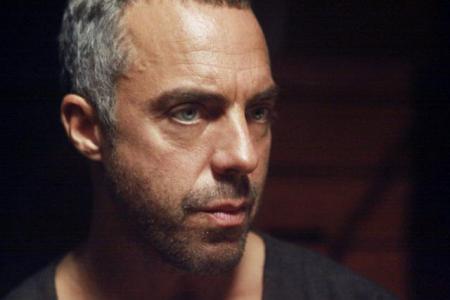
The episode only truly worked in scenes between the adult Jacob and MiB, but that could just be Titus Welliver (left) and Mark Pellegrino’s outstanding acting mixed with a bit of William Blake. In one nice twist, after running away to join the original Others 30 years prior, MiB admits that his mother was right, the island people are bad, but he sees them as a “means to an end” — much like how he sees the Oceanic 815ers later. Jacob, initially reluctant to join him at the Others' camp, now defends people to MiB as “not all that bad.” “Easy for you to say,” challenges MiB, “looking down on us from above.”

This exchange reminded me of William Blake’s Songs of Innocence and Experience, but maybe only I could be thinking that. Hear me out. Jacob is the innocent — “I don’t want to leave the island,” “I love Mother,” etc. MiB is the song of experience. Read "Tyger Tyger" lately? Just substitute Smoke Monster for the tiger. Blake’s poems on innocence are often ironic: it is not enough to be good. MiB understood this better. You must also have an understanding of evil, an understanding of the world. To be experienced contains wisdom and thereby the more desirable of the two states of being; both characters are on a journey toward this state. If you were so inclined to follow this parallelism further, the mythical nature of the queasily golden cave is innocence while the electro-magnetic fields of the island would be scientific experience.

It appears that by evoking William Blake, I have talked myself into liking an episode that I initially hated. One of Lost's true talents is soliciting a viewer response out of proportion to what is actually offered. What do you think? Does the emperor have clothes?

Here are some points up for discussion. Until "What They Died For,” keep an eye on the camp for me:

Was Foster Mom undoubtedly responsible for this initial purge? Was Jacob involved? Ben?

Foster Mom arranged that the boys can’t harm each other, but Jacob certainly found a loophole, sending BiB down the golden spring. We now know why we see boy Jacob with blood on his hands, having been responsible for his brother’s corporeal death.

Jacob doesn’t know how to lie. In fact, in much of "Across the Sea," Jacob doesn’t seem to know how to do much at all except weave. He appears a bit slow.

Cute, cute babies, but why must Lost do such unintentionally funny childbirth scenes?

Happy belated Mother’s Day from Lost: we thought the show had a father fixation. Now we know that it’s all Mom’s fault.

Why does Claudia ask “to see him” not “see them,” or am I hearing that wrong?

The scene between BiB and his dead mother implies that Jacob can’t see dead people. Can BiB because he will die?

The mere existence of the twins’ foster mother is problematic: where did she come from. Who is her mother? Oh, see. Every question I pose does lead to another. I’ll stop.

This article was originally published on Blogcritics.